
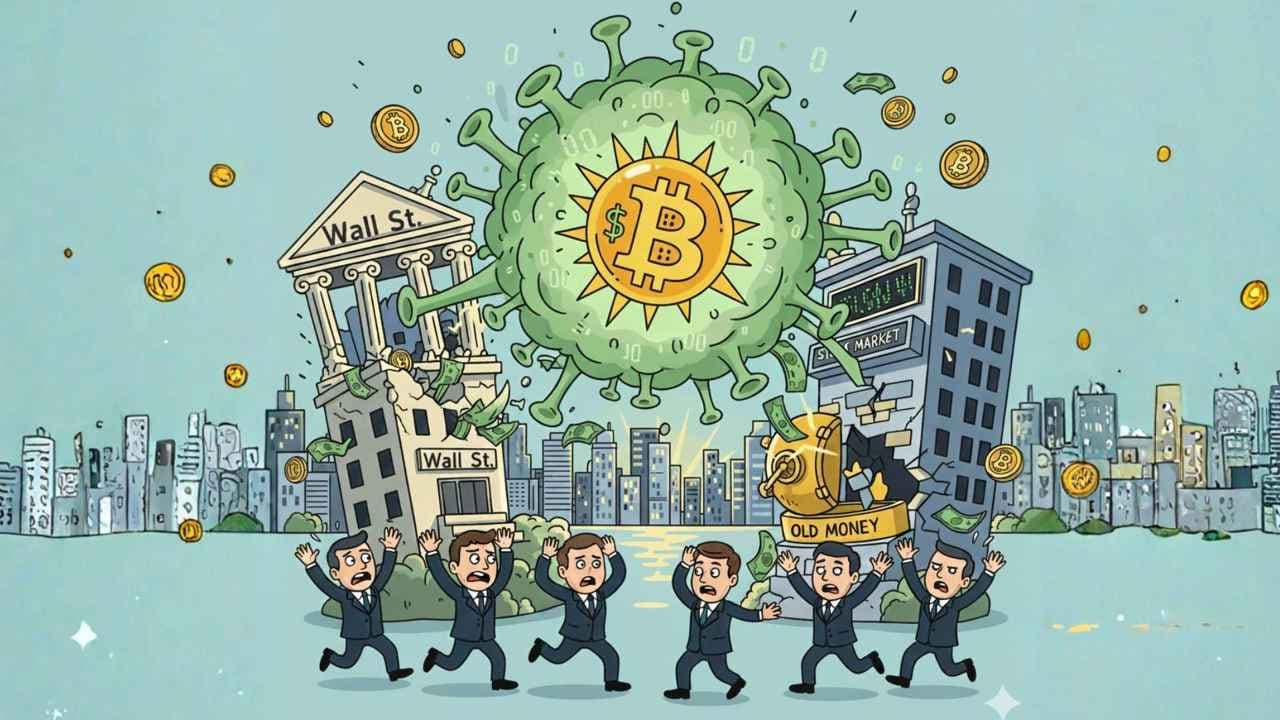
Can Bitcoin bring down the global financial system?

Bitcoin has vaporised more than US$800 billion in its latest crash and sucked US$1 trillion out of the broader crypto market.
With nearly US$2 trillion in market value and rising allocations from Wall Street firms, ETFs, pension funds, and insurers, Bitcoin is increasingly woven into traditional finance.
So the real question is unavoidable: can an asset this volatile, and this widely owned, become the spark that threatens the system holding it?
There was a time, not long ago, when the idea that Bitcoin could topple the global financial system belonged firmly in the tinfoil-hat corners of the internet.
A digital token birthed from a cypherpunk manifesto was never supposed to mingle with pension funds, banks, and hedge-fund balance sheets.
Yet here we are, with Bitcoin flirting with a US$2 trillion market cap and making itself very comfortable in the heart of traditional finance.
In its latest tantrum, Bitcoin wiped out roughly US$800 billion of value, more than the GDP of Switzerland, dragging the broader crypto market down by over US$1 trillion.
Impressive destruction, sure.
But the more important question isn’t how hard Bitcoin can fall; it’s who’s standing underneath it.
Thanks to spot Bitcoin ETFs, Wall Street is now sitting in the front row.
Hedge funds like Millennium have nearly US$2 billion in exposure.
JPMorgan and Goldman Sachs hold hundreds of millions in shares and derivatives.
Even public pension funds, designed to be boring, have quietly loaded up on IBIT.
A 30% drop at today’s scale can carve hundreds of millions off a single institutional portfolio, assuming no hedges.
And while the pros are never truly naked long, the fact remains: Bitcoin has outgrown its role as a speculative sideshow.
It is threaded quite elegantly into the machinery of global finance.
Skeptics insist that, at US$2 trillion, Bitcoin is still too small to be “systemic.”
A rounding error compared to global stocks and bonds. But systemic risk isn’t just about size; it’s about where the wiring runs.
And Bitcoin’s wiring now runs straight through the US$11 trillion global ETF ecosystem.
Those same ETF intermediaries - market makers, authorised participants, liquidity desks - handle everything from S&P 500 flows to bond market trades.
If Bitcoin ETFs suffer heavy losses in a crash, the forced selling won’t stay politely inside the crypto sandbox.
Then comes leverage, the accelerant of every good financial crisis. ETF shares used as collateral. Bitcoin futures margined to the hilt.
When prices snap lower, margin calls travel fast, and suddenly funds are dumping Treasuries, IG credit, and equities just to plug holes in their Bitcoin books.
And let’s not forget the wealth effect.
With crypto wealth above US$3 trillion and beloved by younger, high-beta investors, a large wipeout hits both confidence and consumption.
Neo-brokers, fintech darlings, innovation ETFs - they all dance to Bitcoin’s mood swings now.
Banks aren’t immune either.
Under Basel rules, unhedged crypto exposure carries a punishing 1,250% risk weight.
If Bitcoin’s volatility spikes, banks may have to slash exposure or tighten lending just to stay compliant, further starving markets of liquidity.
Then there’s the policy risk. Regulators are already twitchy about crypto’s growing gravitational pull.
A Bitcoin crash that burns households or pension funds could spark a regulatory crackdown - new taxes, tighter ETF rules, or caps on bank exposure.
Nothing spooks markets like politicians discovering a “new priority.”
So, can Bitcoin actually bring down the global financial system?
Maybe not in the theatrical, apocalyptic way crypto skeptics fantasize about. But could it act as the accelerant in a broader financial fire? Absolutely.
Bitcoin now lives in the same pipelines that carry stocks, bonds, and cash around the world. It’s linked to leverage, collateral, liquidity desks, and ETF flows.
The myth of “crypto in isolation” died the moment Wall Street started selling Bitcoin in shrink-wrapped form.
The real question isn’t whether Bitcoin is dangerous - it’s whether the financial system has digested it safely, or just swallowed a volatility grenade with the pin still attached.
Bitcoin isn’t a villain. But it has quietly become a pressure valve for global risk appetite - and, increasingly, a pressure point.
Investors don’t need to panic. They just need to realise that Bitcoin is no longer outside the system. It’s inside the bloodstream.
